Sabrina
The Cabin at the End of the WorldSabrina begins as one of four strangers who arrive at Andrew and Eric’s New Hampshire cabin claiming that a catastrophic event can be prevented only if the family chooses one of its members to die. Her importance lies in the reversal that follows: she helps impose the demand, yet becomes the visitor who tries to help the family leave. Even that apparent change does not resolve the conflict. At the end, she gives Eric a final, ambiguous warning and dies before he can act on it.
Identity and Background
Sabrina introduces herself as a post-operative nurse from Southern California. She has worked in that role for almost five years and had planned to return to school to become a nurse practitioner. She says she spent most of her savings traveling to New Hampshire to speak with the family, making clear that her arrival is a deliberate commitment rather than a chance encounter. Her account also places her in a complicated family life: she has a younger half-sister, and she connects that sister to Wen, telling the child that she reminds her of her.
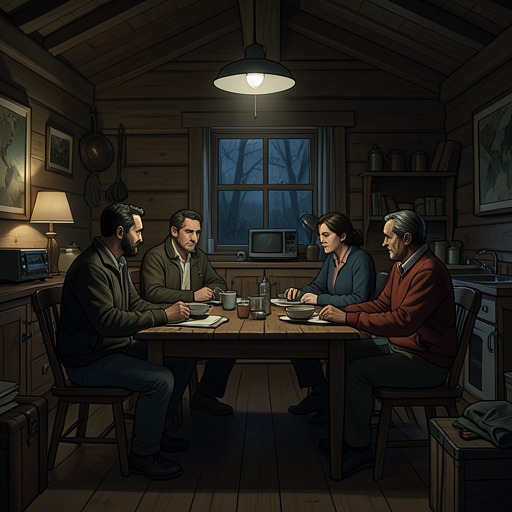
Her first encounter with the family combines an everyday, hesitant manner with immediate control over their options. When Eric says they will call the police, Sabrina explains that their cell service has failed and admits that she cut the cabin’s landline. She introduces herself awkwardly after disclosing the sabotage. The contrast matters: she presents herself as someone approachable while helping ensure that the family cannot summon outside assistance.
Sabrina later explains that she and the other visitors had been experiencing related dreams, nightmares, messages, and visions. Finding others who reported the same experiences relieved her fear that she was undergoing a mental breakdown and ended her obsessive attempts to diagnose herself. The shared visions thus offer her both a frightening warning and a community that seems to confirm her perceptions. She also recalls that Redmond behaved offensively on the message board where they encountered one another, but the possibility of finding people with similar experiences initially outweighed her unease.
Enforcing the Visitors’ Demand
During the cabin confrontation, Sabrina takes her turn presenting the visitors’ case. She acknowledges that their claim sounds extreme, says they wish the circumstances were different, and asks the family to trust them and make what the visitors consider the right decision. Andrew recognizes a pattern in the group’s approach: one speaker gives way to another, each restating the same demand in a more palatable form. Sabrina’s friendly manner therefore functions within a collective effort to persuade, not as evidence that the family is free to refuse.
Her concern for Wen nevertheless sets a limit on what she is willing to make the child witness. When a television broadcast shows the tidal wave at Haystack Rock, Leonard insists that the family must see it. Sabrina steps in front of Wen and offers to take her to her room instead, rejecting the idea that the child needs to watch more. This is a pointed departure from the group’s insistence that the family be confronted with proof: Sabrina treats Wen’s immediate wellbeing as more important than the visitors’ demonstration.
After Redmond attacks Andrew, Sabrina joins Adriane in striking him with her weapon. The assault is a collective act, and Sabrina’s participation connects her to the group’s violence even as her later conduct diverges from its purpose. The following hours are marked by a stark return to routine. She searches beneath the kitchen sink for cleaning supplies and scrubs blood from the floor while Adriane cleans the weapons and restores furniture. Andrew and Eric remain tied to their chairs. The ordinary work of cleaning and preparing food does not undo what has happened; it makes the confinement continue amid domestic tasks.
Doubt and Defection
The visitors’ confidence strains as events accumulate. Sabrina repeatedly offers coffee the next morning and keeps glancing toward the deck, where a foul smell comes from old garbage. Later, when Andrew challenges the group about the earthquake, Sabrina tries to explain that the strangers came together because they had visions and believed they had been sent to the cabin. Her explanation falters under his question about whether they knew of the earthquake beforehand. She first denies that this is what she means, then admits the question has exposed a contradiction in her account. The exchange does not establish precisely what Sabrina knew in advance, but it shows that the group’s explanation is not secure even to those delivering it.
After Wen’s death, Sabrina comes up from the basement carrying her weapon without holding it in a threatening way. She tells Andrew and Eric that she has been listening to them and to the television, understands that they did not stop the catastrophe, and is truly sorry about Wen. Her clothes and face show that she has been in the cabin through the aftermath, but her apology does not erase her earlier role in the visitors’ demand or in Redmond’s death. Instead, it marks a break: she stops insisting that the family comply and offers to help Andrew and Eric leave.
The Keys and the Escape Attempt
Sabrina knows where the visitors hid the keys to Redmond’s truck. She explains that the truck is three miles from the cabin and describes the hiding place halfway along the dirt road: beneath a flat, slate-colored stone, partly covered with lichen, near a pine tree with a large knot in its trunk. The group had also left their phones and wallets in the truck. Sabrina says the arrangement was intended as a safeguard against Andrew overpowering them and driving away, leaving the world to die. She now offers to reverse that plan by helping Andrew and Eric reach the vehicle.
Andrew distrusts her and threatens to hurt her if she misleads him. Sabrina maintains that she will show them the keys, and proposes that they can leave her by the road or take her to the police afterward. When Andrew checks Redmond’s shoes and finds no keys, Eric says he does not think Sabrina is lying. Sabrina repeats that the hiding place will be difficult to find without her. Her knowledge proves specific: once the three reach the described spot, she runs a few steps into the woods, lifts the flat stone beside the knotted pine, and searches beneath it. She throws Andrew the keys on a red keychain. At that point she says the truck is about another mile down the road.
The retrieval is also the last clear opportunity for the escape to proceed as a practical plan. Sabrina’s bound rope slips off intact as she runs, an inexplicable release that changes the balance between her and the two men. Andrew points his gun at her but cannot bring himself to place a finger on the trigger. Sabrina has produced the keys, yet her other arm is inside a dark blue vinyl bag, and Andrew demands to know what she is doing. The promised help has become difficult to distinguish from another danger.
Death and Narrative Role
Sabrina raises the gun and presses it to her temple while her free hand makes confused, conflicting gestures. Andrew tells her to put it down. Eric, who has stood up too quickly and briefly closed his eyes to steady himself, sees her turn toward him. Sabrina tells him that he still has time to save everyone, even after what has happened, but that he must act quickly. She then begins another sentence before the gun fires. The warning gives Eric a possible course of action without explaining what it means or how it might be carried out; her death leaves that possibility unresolved.
Sabrina’s arc is not a clean passage from complicity to redemption. She helped isolate the family, supported the demand for a sacrifice, and participated in the violence against Redmond. She also tried to spare Wen from the television broadcast, apologized after Wen’s death, and supplied Andrew and Eric with the location of the keys. These actions remain in tension rather than canceling one another. Her final, unexplained warning intensifies that uncertainty: even as she acts to help the family escape, the group’s beliefs and the disasters they predicted continue to shape what she says and does. Her story ends at the boundary between agency and compulsion, with the keys delivered but the meaning of her last message left to Eric.